
How to Build a Startup That Stands Out
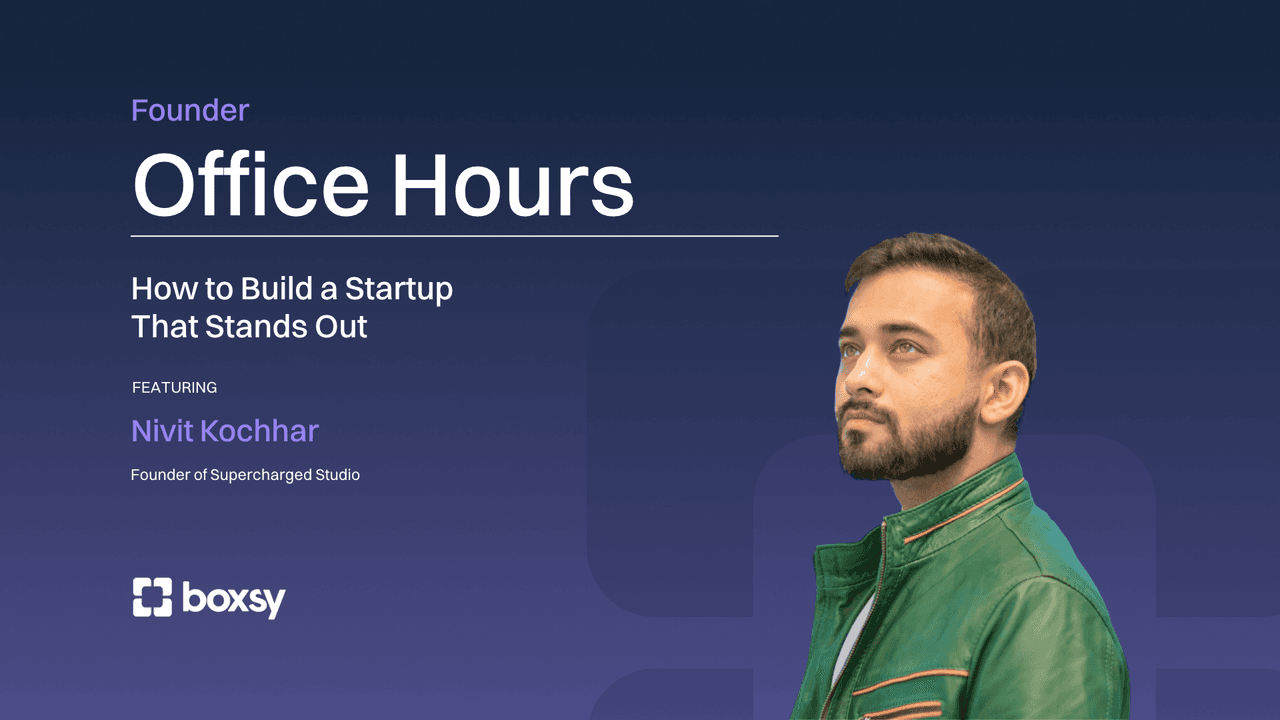
For early-stage founders, building a great product is only part of the equation. You also need to
communicate its value, establish a recognizable brand, and create a digital experience that
gives potential customers a reason to trust you.
But translating a vision into a brand that actually reflects the business you're building can be
harder than it looks. A website might explain what your product does without communicating
why it matters. Your brand identity might look polished but fail to connect with the audience
you're trying to reach.
On our most recent episode of Boxsy Office Hours, we sat down with Nivit Kochhar, Founder of
Supercharged and one of Boxsy's preferred partners, to discuss how early-stage founders can
approach branding, positioning, and website design more strategically.
With five and a half years of experience helping startups bring their ideas to life, Nivit works with
founders to develop their brand identities, build high-converting websites, and connect their
products with the audiences they are designed to serve.
We covered everything from the importance of a clear elevator pitch to the role of AI in brand
differentiation and where founders should focus when working with limited time and resources.
Here are some of the biggest takeaways.
1. Your Website Should Tell Your Story in 10 Seconds
One of the most common challenges Nivit sees with early-stage founders is the disconnect
between the business they envision and how it actually comes across online.
Founders often have a clear picture of the product they're building, but their website doesn't
always communicate that vision. The result is a digital presence that doesn't reflect the quality,
ambition, or value of the business.
According to Nivit, a good starting point is to think about your website the same way you would
approach an elevator pitch. When someone lands on your homepage, they should be able to
understand three things almost immediately:
● Who: Who are you building this for?
● What: What are you building or offering?
● Why: Why does it matter to your audience?
Your homepage should communicate these answers without making visitors work to find them.
Nivit recommends keeping the hero section particularly focused. Rather than filling it with
complicated language or unnecessary details, use clear messaging that communicates your
value proposition.
Once visitors understand what you do, you can build credibility with supporting elements such
as customer testimonials, social proof, and recognizable logos. The goal isn't to tell your entire
company story above the fold. It's to give someone enough information to understand why they
should keep exploring.
2. Start With Positioning, Not Your Logo
When founders think about branding, they often jump straight to visual decisions. They start
looking at logos, typography, color palettes, and website inspiration before establishing what
their brand actually needs to communicate.
Nivit suggests taking a different approach, and instead starting with positioning.
Before making visual decisions, founders should understand who their audience is, what they're
offering, and why their solution matters. From there, they can begin defining the personality of
the brand.
For example, a brand built around high energy and a younger Gen Z audience will likely
communicate very differently from one targeting established enterprise decision-makers. That
personality should influence everything from the language you use to the colors, typography,
and overall visual direction.
Nivit breaks the process into three important considerations:
● Positioning: Who are you speaking to, what are you offering, and why should they
care?
● Personality: How should your brand feel? What characteristics do you want people to
associate with it?
● Visual identity: How do your colors, typography, logo, and design choices bring that
positioning and personality to life?
The logo, he explains, should be one of the last things you focus on, not the first. Without a
clear understanding of your positioning, visual decisions are often made based on personal
preference rather than what will resonate with your intended audience.
3. More Website Traffic Doesn't Automatically Mean More
Customers
Getting people to your website is one challenge. Converting those visitors into customers is
another.
For early-stage startups investing in advertising, content, and other marketing channels, Nivit
emphasizes the importance of understanding where visitors are coming from and what they do
once they arrive.
Someone discovering your company through a Reddit discussion may have very different
expectations from someone clicking through a YouTube ad or finding you through a blog post.
Your website experience should reflect that.
For example, if someone clicks on an advertisement about a specific product or feature, they
should ideally land on a page that continues that same conversation. Sending every visitor to a
generic homepage can create unnecessary friction.
Nivit recommends looking at the full visitor journey:
● Where are people discovering your business?
● Which pages are bringing visitors to your website?
● Where are visitors going next?
● At what point are they leaving?
● Are the pages they're landing on aligned with the messaging that brought them there?
Understanding these patterns helps founders identify where their website experience might be
falling short. He also highlights the importance of balancing evergreen website content with
campaign-specific pages.
Your core website should consistently communicate what your business does and why it
matters. Campaign pages, on the other hand, can be adjusted as your marketing priorities
change.
In fast-moving industries like technology and SaaS, messaging and campaigns may need to
evolve frequently. The important thing is to make those changes intentionally and continue
reviewing website performance to understand what's working.
4. Building a Distinct Brand in an AI-Driven Market
With AI making it easier than ever to create websites, generate content, and develop visual
assets, founders have more tools available to them than ever before. However, having access
to those tools doesn't necessarily mean your brand will stand out.
Nivit makes an important distinction between three concepts that are often used
interchangeably: brand, brand identity, and branding.
Your brand is the perception other people have of your business. It's what your customers and
audience think, feel, and say about you.
Your brand identity is the foundation you establish internally. This includes your positioning,
personality, visual direction, typography, and other elements that define how you want your
business to be recognized.
Branding is the process of consistently communicating that identity through the way your
business shows up.
This distinction matters, particularly as more companies use similar AI tools to create their digital
presence. AI can help founders move faster, experiment with different creative directions, and
produce content more efficiently. But it doesn't replace the need to understand your audience or
establish a clear identity.
Nivit's advice is to keep the foundations simple and consistent. Establish your positioning,
choose your visual direction, and continue experimenting with how you communicate your
brand. Over time, that consistency helps build recognition and shape how people perceive your
business.
5. You Don't Need a Huge Website to Build a Credible
Startup
For founders working with limited funding, deciding where to invest in branding and marketing
can feel overwhelming. Should you prioritize a complete brand identity? Invest in a custom
website? Focus on advertising or customer acquisition?
Nivit's answer depends largely on the market you're entering. If you're building in a highly
competitive industry, having a strong brand can be an important differentiator. When customers
have multiple similar solutions to choose from, how you position and present your business can
influence whether they pay attention.
However, if you're introducing a niche solution or entering an entirely new market, your priorities
may look different. You might not need to invest as heavily in a complex brand identity at the
beginning.
One of his biggest recommendations for early-stage founders is to avoid overbuilding their
websites. A common misconception is that a credible startup needs a large website with
multiple pages, extensive animations, and sophisticated design features.
In reality, a well-designed one-page website can be enough to communicate your value
proposition, establish credibility, and guide visitors toward taking action.
The priority should be clarity and functionality, not the number of pages. As your business
grows, your website can grow with it. There's no reason to invest in an elaborate digital
experience before you understand what your audience actually needs.
6. The Three Things to Review Before Launching Your
Website
When asked what he would look at if he had 30 minutes to review an early-stage founder's
website, Nivit identified three areas that deserve immediate attention.
1. Messaging
Is your website clearly communicating who you are, what you do, and why it matters?
Can someone understand your offering without having to search through multiple pages? Is
there a clear next step for visitors to take?
If your messaging is confusing, even the strongest visual identity won't make up for it.
2. Testimonials and social proof
Does your website give visitors a reason to trust you?
Testimonials, customer feedback, recognizable client logos, and other forms of social proof help
establish credibility. Especially for early-stage businesses, these elements can help reassure
potential customers that your product or service delivers on its promise.
3. Website flow and architecture
Does the website guide visitors through the information in a logical order?
Think about how each section connects to the next. Your website should introduce the business,
explain its value, establish credibility, and make it easy for visitors to understand what to do
next. A website can have all the right information and still struggle to convert if that information
isn't presented in the right sequence.
Looking at these three areas can help founders identify some of the biggest opportunities for
improvement without immediately committing to a complete redesign.
Final Thoughts: Build the Brand Around the Business
You're Actually Creating
For early-stage founders, branding doesn't need to be an overwhelming or expensive process.
But it does need to be intentional.
As Nivit shared throughout our conversation, the strongest starting point is understanding your
positioning, knowing who you're building for, and communicating your value clearly.
From there, your visual identity, website, and marketing efforts should all work together to
reinforce the same message.
You don't need a complicated website or an elaborate brand identity to make an impression.
You need a clear story, a consistent presence, and a digital experience that helps the right
people understand why your business matters.
Watch the full video on Youtube, to learn more about what can separate your startup from
others: LINK